Tax Allocation Districts: The Most Efficient and Effective Way to Fund Reinvestment
Strong neighborhoods are not just a civic priority. They are an economic one.
What is a Tax Allocation District?
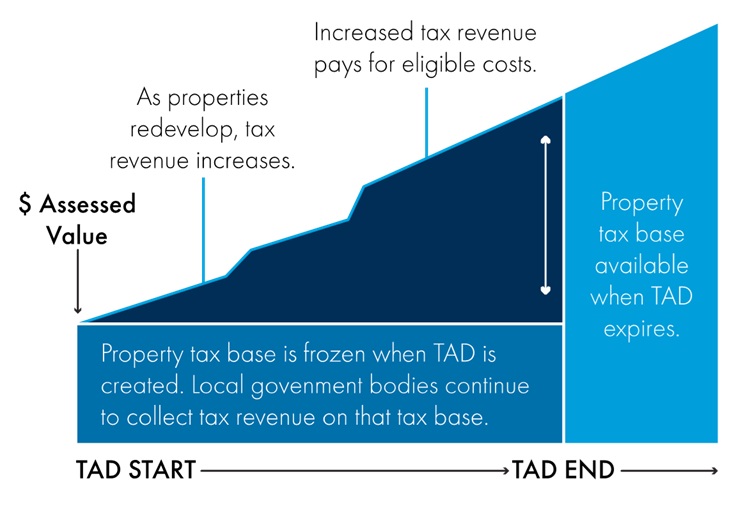
Tax Allocation Districts (TADs) are self-financing mechanisms. When a TAD is established, the base property value is locked. As values rise, base taxes continue to flow to the City, Atlanta Public Schools (APS), and Fulton County.
The incremental revenue created by that growth is reinvested back into the neighborhood, meaning TAD-funded projects are financed by growth within the district itself.
No new taxes.
No additional burden on the rest of the city.
How TADs Work
Atlanta Public Schools and Fulton County TAD Contributions
Atlanta Public Schools (APS) and Fulton County continue to receive their full share of the frozen tax base while a TAD is active.
APS participation in the corridor TADs began in 2024 and is capped at $5 million annually across all four corridors through 2028, increasing to $6.5 million thereafter. This contribution is limited, capped, and applies only to future growth—not existing revenues. Fulton County participates under similar agreements, contributing a portion of incremental growth while maintaining its base revenues.
Both APS and Fulton County also receive revenue during the life of a TAD through Payment in Lieu of Taxes (PILOT) agreements. In FY2025, APS received approximately $4.6 million from the corridor TADs and $19.7 million from the Eastside TAD, with Fulton County also receiving PILOT payments.
When a TAD expires, both APS and Fulton County gain access to the full, increased tax base. For example, the closing of the Atlantic Station TAD in 2025 returned approximately $14 million in new annual tax revenue to APS, with similar long-term gains expected as additional TADs close.
NRI is moving forward. The question is how it will be funded.
The NRI is a strategy that draws on a range of financing sources. TADs are one of those tools, and under Georgia law (O.C.G.A. Title 36, Chapter 44), TAD funds are restricted to capital investment: housing, infrastructure, public spaces, and economic development projects. They cannot fund social services, anti-displacement programs, or early education directly. Those require separate programmatic funding.
What makes TADs uniquely valuable is their scale and speed. They offer the greatest capacity to finance capital projects quickly, using neighborhood-generated growth rather than new taxes.
Without TAD extension, the NRI continues, but the funding mix shifts. Alternative tools, like general obligation bonds or citywide millage increases, may become more central, spreading costs more broadly across all Atlanta taxpayers rather than drawing from the growth those neighborhoods generate.
Next
Why Extend
Concrete outcomes: housing, grocery stores, infrastructure, and more.